
Roof flashing repair Georgia homeowners can spot usually starts with a small clue, not a collapsed roof. Water stains on a ceiling, dark streaks on fascia, or lifted metal at a wall can all point to flashing that no longer sheds water. Flashing is the metal, or sometimes a formed boot, that covers joints shingles cannot seal by themselves. Those joints include sidewalls, valleys, pipes, skylights, chimneys, and the roof edge.
Call (404) 445-8136 to request a roofing evaluation. If water is already reaching the deck, the wall, or the ceiling, request prompt help and avoid climbing onto the roof. You can also review roofing installation services before your consultation.
This guide covers the flashing types you can compare from the ground. It also covers the signs that separate a local repair from a wider roof problem, and the questions to ask before anyone opens the roof. Chimney-only leaks have their own path. Pricing for a full replacement, and how to choose a contractor, live on other pages. This article stays on the flashing itself.
What roof flashing repair Georgia jobs actually cover
A flashing repair is not one product and not one price. It is a location-specific fix. The roofer has to match the metal, the overlap, and the layer underneath to the joint that failed. On a north-metro Atlanta house, that joint is often a dormer sidewall, a plumbing vent, a valley between two roof planes, or the metal at the eave and rake.
Georgia rain makes those joints work harder than a dry climate would. A summer storm can dump a large volume of water onto one slope in a short time. That water looks for the first gap. If the metal is lifted, rusted, or installed in the wrong order, the gap is the wall or the deck, not the gutter.
The U.S. Department of Energy’s Building America Solution Center says step and kick-out flashing should be installed at roof-wall intersections. Pieces should overlap so water sheds outward. The same guidance calls for corrosion-resistant metal. Step flashing should extend at least 4 inches up the wall and 4 inches onto the roof deck. Kick-out flashing should send water into the gutter, not behind the siding. Read the Building America step and kick-out flashing guide for the full detail.
All In One Exteriors handles residential and commercial roofing across Alpharetta, Marietta, and nearby north Georgia communities, including repair work that starts at these joints. A useful evaluation names the flashing type, the condition of the shingles and deck around it, and whether a local repair can still shed water.
Which flashing failed: drip edge, step, valley, or pipe boot
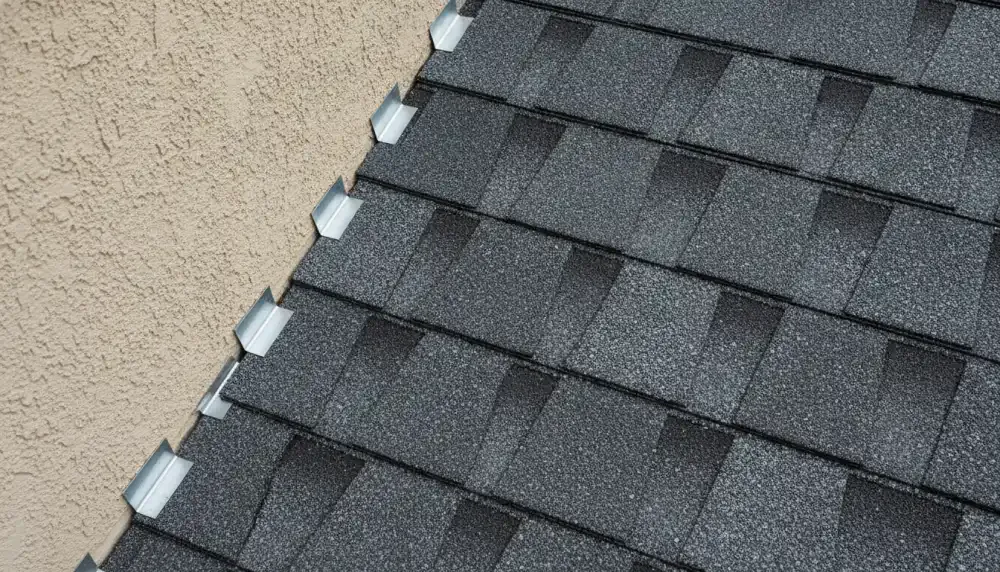
Homeowners often say “the flashing” when they mean four different parts. Sorting them before the visit saves a second trip and keeps a drip-edge problem from being treated like a valley rebuild.
| Flashing type | Where you see it | Common failure | What a repair usually involves |
|---|---|---|---|
| Drip edge. | Eaves and rakes, just above the gutter or fascia. | Bent, missing, or back-lapped metal that lets water run behind the fascia. | Reset or replace the edge metal. Then check the starter course and fascia. |
| Step flashing. | Where a sloped roof meets a sidewall or dormer. | One long piece of metal, or pieces that no longer overlap like shingles. | Open the courses and install overlapped pieces. Tie them into the wall wrap. |
| Kick-out flashing. | The low end of a roof-wall intersection. | Missing diverter, so runoff shoots behind the siding. | Add a diverter sized for the water volume. Tie it to the gutter. |
| Valley metal. | The V where two roof planes meet. | Debris dams, pinholes, or shingles fastened through the metal. | Clear and inspect. Then repair or rebuild the valley liner. |
| Pipe boot. | Around a plumbing vent or round penetration. | Cracked rubber collar, or a boot that has slipped down the pipe. | Replace the boot. Re-weave the shingles around the new flange. |
| Counter flashing. | The visible cap over base flashing at masonry. | Pulled away from the mortar joint, often at a chimney. | Reset into the joint. Chimney leaks need their own inspection. |
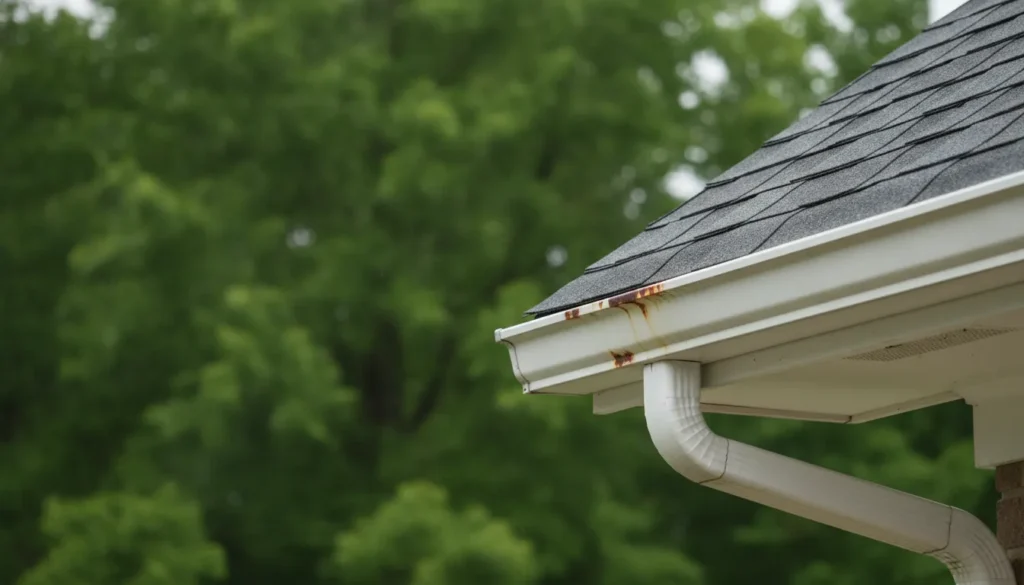
Drip edge is the piece the parent question often starts with, and it belongs in this repair conversation. It is a bent strip of metal at the roof edge. Its job is to kick water into the gutter instead of letting it curl back onto the fascia or the top of the wall. When it is missing, rusted through, or installed over the underlayment in the wrong order, the stain shows up on the fascia board or in the soffit before it shows up in a bedroom.
Step flashing is a series of small L-shaped pieces, one at each shingle course, where the roof climbs a wall. A single continuous strip nailed across that joint is a frequent shortcut. It looks tidy from the ground and it leaks, because water that gets behind one course has a straight path down the wall. Kick-out flashing is the last piece in that run. Without it, even correct step flashing can dump water behind the siding at the bottom corner.
Valley flashing and pipe boots fail differently. Valleys collect leaves, granules, and the most water on the roof. Pipe boots fail when the rubber collar hardens in the sun and splits. A split collar is often a local repair. A valley with soft decking under it is not.
Signs the metal is failing before the ceiling stains
You do not need to climb the roof to gather a useful first look. Stay on the ground or on a stable ladder only if you already use one safely. Binoculars and a dry day are enough for most of these checks.
- Walk the drip line. Look for rust streaks, a wavy metal edge, or shingles that overhang so far the metal is hidden and water drips on the fascia.
- Check the fascia and soffit under valleys and eaves. Dark streaks, peeling paint, or a soft board mean water has been missing the gutter.
- Look at sidewalls and dormers. A continuous metal strip, a gap at the siding, or a missing kick-out at the bottom corner is a leak path.
- Find each plumbing vent from the yard. A collar that is cracked, tilted, or sitting below the shingle line is a pipe-boot problem.
- Note what happens in the next hard rain. Overflow at one gutter corner, or a wet spot that appears only on the wall below a roof intersection, points to kick-out or drip-edge trouble.
- Photograph the spot from two angles and write down the room underneath. That record helps the roofer separate a flashing leak from an attic or ventilation issue.
Inside, a stain does not always sit directly under the bad metal. Water can travel along a rafter or the top of a wall before it shows on drywall. A ceiling spot near a bathroom is not proof the pipe boot failed. A spot near an exterior wall is not proof the drip edge failed. The roofer still has to open or probe the assembly.
Granules in the gutter, a lifted shingle tab, or a valley packed with debris can travel with a flashing problem or stand alone. If the shingles around the metal are brittle, cupped, or already patched with roof cement, a metal-only repair may not hold. Say that plainly in the visit. A smear of sealant over a lifted edge is a temporary dry-in, not a finished repair.
Repair, rebuild, or leave it until the next replacement
A local repair is the right call when the metal failed and the deck, underlayment, and surrounding shingles are still sound. Typical examples are a split pipe boot, a short run of rusted drip edge, or a few step pieces that were face-nailed and have pulled loose. The roofer removes the affected courses, replaces the metal in the correct overlap, and puts the shingles back so water still sheds downhill.
A rebuild of that detail is different. It is needed when the wrong flashing style was used in the first place. It is also needed when siding sits tight against the shingles, or when water has softened the deck or the wall sheathing. Step flashing that was never tied into the wall wrap often falls in this group. So does a kick-out added on the surface after the siding went on.
Leave a cosmetic gap alone only if a roofer has confirmed it is not a water path. Exposed fastener heads, a small dent in drip edge, or metal that has dulled with age are not automatic repairs. Active leaks, rotten fascia, and daylight at a wall joint are not cosmetic.
If the field of the roof is near the end of its life, patching one joint can be wasted money. The Atlanta roof replacement cost guide is the place for price ranges. This page will not repeat those figures. Ask the evaluator whether the flashing can be repaired in a way that still makes sense if the rest of the roof is replaced in the next few seasons.
Storm damage is a separate question from ordinary wear. Wind can lift edge metal and bend a valley. Hail can bruise shingles around a boot without splitting the collar. If you are weighing a claim, start with the Georgia storm-damage roof insurance claim guide. Keep this article focused on the repair itself. No contractor can promise what a carrier will pay.
What a Georgia roofer should check on site
A useful flashing visit is short on guesses and specific about layers. Ask for the findings in writing, even if the repair itself is small. The notes should name the joint, the material, and what was wet.
On a drip-edge call, the roofer should look at the gutter line, the starter shingles, and the fascia behind the metal. Water that curls back often shows as a stained or soft board, not as a hole you can see from the driveway. Replacing the metal without checking that board leaves the leak in place.
On a sidewall, the check includes the step pieces, the kick-out, the siding clearance, and whether house wrap laps over the metal. Siding that sits on the shingles traps water. The Building America guidance calls for siding to end at least about an inch above the roof surface, with shingles covering the roof leg of the step flashing. A repair that recaulks the siding and leaves the metal untouched does not meet that idea.
On a valley or pipe boot, the roofer should say whether the deck is solid. Soft wood, stained sheathing, or a previous coating of roof cement changes the scope. If the leak has reached the ceiling, an interior look matters too, but the repair still happens at the roof, not with paint.
All In One Exteriors can fold this kind of detail into a broader roofing repair when the flashing is only one part of an active leak. If water is coming in during a storm and you need the opening covered first, emergency roofing service is the right request. Dry-in and a finished flashing repair are not the same visit.
Questions to ask before you approve the repair
Bring these questions to the evaluation. The answers tell you whether the proposal matches the joint that failed.
- Which flashing type failed, and is any nearby flashing still sound?
- Will you replace pieces in an overlap that sheds water downhill, or seal the existing metal?
- What did you find at the deck, underlayment, fascia, or wall sheathing?
- If this is a roof-wall joint, will the repair include a kick-out into the gutter?
- Are the surrounding shingles reusable, or do they need a wider patch to match?
- Is this a local repair, or should we compare it with a planned replacement?
- What is and is not covered if the leak returns at the same joint?
Ask for photos of the opened joint if the crew has to lift shingles. Those photos are the best record of whether the deck was dry. They also help if a later stain shows up in a different room.
Financing is sometimes available for larger exterior projects through the lender programs All In One Exteriors can introduce. Approval, rates, and terms are the lender’s decision, not a promise tied to a flashing repair. For a small metal replacement, most owners simply compare the written repair scope.
If the edge problem is a gutter pulling away, overflowing, or dumping water on the fascia, start with gutter repair in Atlanta. Do that before you replace drip edge that is still doing its job. Flashing and gutters meet at the eave. They fail for different reasons.
How drip edge repair fits the larger flashing job
Drip edge deserves its own pass because people can see it from the yard. A bad edge is often blamed on the gutter. The metal should project into the gutter. It should not stop short, and it should not sit so high that water misses the trough. At the rake, it should cover the deck edge so wind-driven rain does not blow back under the shingle.
A repair at that edge is usually straightforward when the deck nose is solid and only a section of metal is bent, rusted, or missing. The crew lifts the starter course, sets new metal, and refastens the edge without driving nails through the face of the drip edge where water runs. If the fascia is rotten, the carpentry comes first. New metal on a soft board will sag and reopen the path.
Drip edge is not a substitute for underlayment. Underlayment is not a substitute for drip edge. If a prior job left the edge metal off, or tucked it so water runs toward the wall, correct the order. Do not add a second strip on top. A caulk line along the gutter apron rarely holds through a Georgia thunderstorm season.
When the same house also has a tired shingle field, treat the edge repair as information, not as the whole plan. A sound drip edge on a failing roof still leaves you with a failing roof. The evaluation should say which of those two things you are buying.
What not to confuse with a flashing leak
Several nearby problems mimic flashing and lead to the wrong repair. A clogged gutter can overflow at the corner where a kick-out should sit. Attic condensation can stain a ceiling with no roof opening at all. A chimney cap, a cracked crown, or counter flashing pulled from the joint is a chimney problem. Use the chimney flashing and roof leak guide for that case, not a general flashing repair.
Skylights, satellite mounts, and solar attachments each have their own flashings. Do not assume a curb or a boot from one penetration fits another. If the deck itself is soft across a wide area, the conversation shifts to roof decking replacement. Replacing metal over rotten wood does not stop the leak.
Interior paint, bleach, and a new gutter screen do not repair flashing. They can hide the stain or change how overflow looks. Keep the photos from before any of that work so the roofer can still see the original pattern.
Frequently asked questions
How do I know if I need roof flashing repair or a roof replacement?
You need a flashing repair when one joint has failed and the deck and surrounding shingles are still sound. You compare replacement when the shingle field is worn out, several joints have failed, or the deck is soft. A written evaluation should say which one applies before you approve work.
Can I see drip edge damage from the ground?
Often, yes. Look for rust, a bent or missing metal lip, stains on the fascia, and water that drips behind the gutter in a hard rain. You still need a close look at the deck nose before anyone prices the repair.
Is sealant a real flashing repair?
Sealant can hold a small gap for a short time or finish a properly rebuilt joint. It is not a repair by itself when the metal is missing, lapped backward, or sitting on rotten wood. Ask what metal is being replaced, not only what is being coated.
Does a pipe boot count as flashing?
Yes. The boot is the flashing for a round penetration. A cracked collar is one of the more local repairs on an asphalt roof. The flange still has to be woven into the shingles so water sheds over it, not under it.
Who should I call for a sidewall leak in Alpharetta or Marietta?
Call a roofing contractor who will inspect the step flashing and the kick-out, not only the shingles in the field. All In One Exteriors evaluates these joints for homes and commercial buildings in those communities and the surrounding area.
Book the evaluation while the joint is still a small repair
Flashing leaks rarely stay the size of the first stain. Water that misses the gutter or runs behind siding starts to soften wood, and the repair grows from metal into carpentry. If you already have a photo of lifted edge metal, a cracked boot, or a wet wall below a roof intersection, that is enough to start.
Call All In One Exteriors at (404) 445-8136 or request a roofing evaluation and ask for the flashing type, the deck condition, and a repair scope in writing.