
After hail or high winds, the roof repair bill is only one part of the decision. Your out-of-pocket cost may also depend on the policy deductible, whether the insurer applies depreciation, what damage is documented, and whether the work falls within a covered loss.
Request a Georgia storm damage roof evaluation from All In One Exteriors
The storm damage roof repair cost georgia insurance question has no single answer because coverage, exclusions, deductibles, and payout rules vary by policy. Before agreeing to permanent repairs, review the policy and document the roof condition, estimates, receipts, and insurer communications. Georgia’s insurance regulator recommends knowing what is covered, excluded, and subject to a deductible.
A careful evaluation can help separate storm-related damage from maintenance issues and clarify what an estimate actually includes. Start by understanding how homeowners insurance generally treats sudden weather damage, then compare that framework with your policy’s specific language.
What Storm Damage Repairs Are Usually Covered by Homeowners Insurance in Georgia
Homeowners insurance may pay for roof losses caused by weather when the event is a covered disaster under the policy. That distinction matters after Georgia hail, wind, or severe storms. A damaged shingle, flashing area, or other roof component is not automatically covered simply because a storm occurred. The insurer reviews the policy, the reported cause of damage, and the condition of the property.
Georgia’s insurance regulator recommends identifying what the policy covers, what it excludes, and which deductibles apply before making decisions about a claim. Coverage language can differ between policies, so avoid treating a contractor’s initial assessment as a coverage determination. A roofing professional can document visible conditions and prepare an estimate, but the insurance company decides whether the loss falls within the policy.
Maintenance is another important distinction. Storm-related damage may be evaluated differently from deterioration, deferred maintenance, installation defects, or damage that existed before the weather event. A roof evaluation should separate apparent storm impact from ordinary wear rather than assume every repair belongs in the claim. This separation can also help explain why a repair estimate and an insurer’s written scope do not always match.
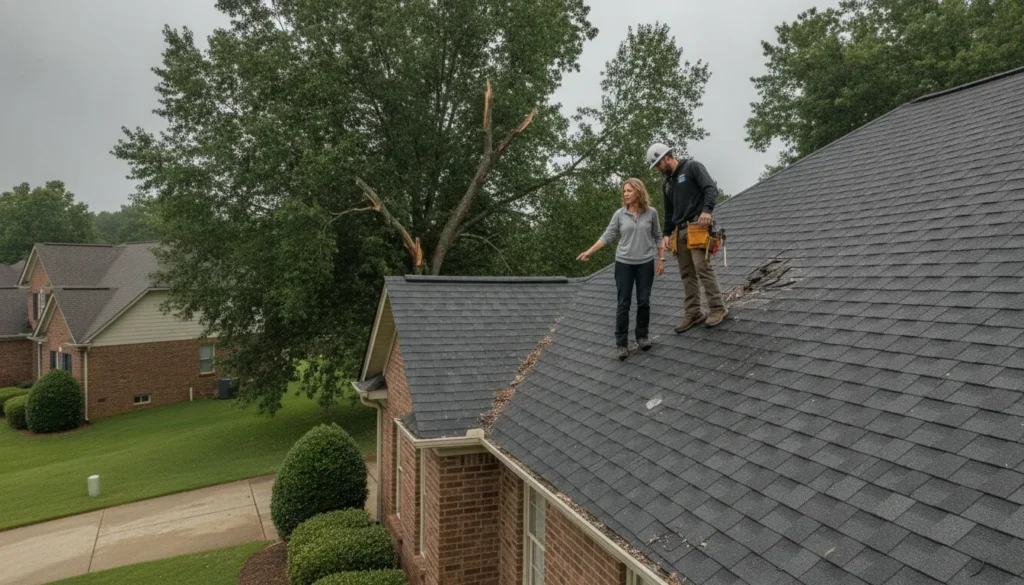
If the roof needs immediate protection, Georgia’s regulator advises photographing or recording the damage when possible, keeping receipts for temporary work, and avoiding permanent repairs before inspection. An insurer may deny a claim if permanent repairs are completed before the damage is inspected. Temporary protection can reduce further exposure, but it does not establish coverage.
For the broader documentation and claim context, review this broader Georgia storm-damage insurance guide. Keeping the cost question separate from the coverage question can make it easier to compare the repair scope, deductible, and policy language without assuming a specific outcome.
How Georgia Insurance Changes Storm Damage Roof Repair Cost
Insurance can change the amount a Georgia homeowner pays for storm-related roof work. But the result depends on the policy, the cause of damage, the deductible, and the approved repair scope. Homeowners insurance generally responds to weather losses only when the event is covered under the policy. Georgia’s insurance regulator recommends knowing what the policy covers, excludes, and lists as deductibles before making decisions. Read the broader Georgia storm-damage insurance guide for the claim-process context.
| Situation. | What the policy may do. | What you may owe. |
|---|---|---|
| Covered storm damage with an approved repair scope. | May contribute toward eligible repairs according to policy terms. | The applicable deductible and any non-covered work or upgrades. |
| Damage below or near the deductible. | May provide little or no practical claim payment. | Potentially the repair cost, depending on the final scope and policy. |
| Work outside the covered loss. | May exclude maintenance, unrelated deterioration, or other non-covered items. | The portion not included in the insurer’s approved scope. |
| Minor damage where a claim is not filed. | No insurance payment is requested. | The homeowner pays the contractor directly. |
How the deductible affects the payment
A deductible is the amount subtracted from a claim payment, so it is part of the homeowner’s financial responsibility when a claim is approved. The NAIC recommends checking the deductible before reporting property damage. For minor damage, a homeowner might decide that paying out of pocket is more practical. But that decision should account for the actual repair scope and the policy’s requirements.
Do not assume an estimate, deductible, or coverage decision applies to every Georgia home. Ask the insurer for an itemized explanation of its settlement or scope, and compare it with a documented contractor evaluation. All In One Exteriors can provide a roof assessment and claim-documentation support, while the insurer decides coverage under the policy.
How Actual Cash Value vs. Replacement Cost Coverage Changes Your Payout
Insurance estimates can look different even when they describe the same storm-damaged roof. One reason is whether the policy uses actual cash value (ACV), replacement cost value (RCV), or different treatment for particular roof components. These are general insurance concepts, not a statement of how every Georgia policy handles roof damage.
ACV subtracts depreciation
ACV is the amount needed to repair or replace covered property minus depreciation. Depreciation reflects the age and condition of the property. So an ACV payment may be lower than the projected cost of putting the roof back to its pre-loss condition. The exact calculation depends on the policy, the documented damage, and the insurer’s estimate. The Texas Office of Public Insurance Counsel provides these definitions as general residential insurance guidance: ACV and RCV explained.
RCV may release funds in stages
RCV generally refers to the amount needed to repair or replace covered property without subtracting depreciation. However, a policy that provides RCV coverage may still treat some property, including roofs, on an ACV basis. The policy language controls, and roof treatment can vary by policy. Do not assume that selecting replacement-cost coverage means every roof payment will be calculated the same way.
Some insurers initially pay only part of the RCV and require proof that repairs or replacement were completed before releasing the remaining amount. Keep the repair contract, invoices, receipts, completion records, and relevant communications. Proof-of-repair requirements, deadlines, and eligible costs should be confirmed with the insurer rather than assumed.
When reviewing an estimate, ask which portions are being paid at ACV, whether depreciation is recoverable, and what documentation is needed for any withheld amount. A Georgia roofing contractor can help explain the work shown in a scope, but the insurer determines coverage and payment under the policy.
When Insurance Does Not Cover Storm Damage, and What to Do Next
A storm can damage a roof, but the presence of storm activity does not automatically establish coverage. Homeowners insurance generally pays for weather-related loss only when the event and resulting damage are covered by the policy. Georgia’s insurance regulator recommends reviewing what the policy covers, what it excludes, and how its deductibles apply. The NAIC explains that covered weather losses may be eligible for homeowners insurance benefits, but the policy language and claim facts control the decision.
Questions about age, prior deterioration, deferred maintenance, workmanship, or the cause of damage may affect how an insurer evaluates a claim. Those issues are not universal exclusions, and a contractor should not make a coverage determination. The insurer reviews the policy, the reported cause, inspection findings, and supporting documentation. Do not rely on a general storm damage roof repair cost Georgia insurance estimate as proof that a particular repair will be covered. Coverage, exclusions, deductibles, and payment decisions vary by policy.
Practical next steps after a coverage concern
- Read the declarations page and relevant policy sections for covered perils, exclusions, conditions, and deductibles.
- Photograph or record the damage before making repairs when it is safe to do so. Use temporary protective measures to limit additional damage, but avoid permanent repairs before the insurer has had an opportunity to inspect. Georgia’s regulator cautions that permanent repairs made too early can affect a claim review: review the Georgia insurance claim tips.
- Ask the insurer to explain the concern in writing and identify the specific policy language being applied. Keep copies of the inspection report, correspondence, estimates, and receipts.
- If the explanation remains unclear, consider advice from a qualified insurance professional or attorney. A roofing contractor can help document visible conditions and explain an estimate, but cannot promise coverage or change the insurer’s decision.
Stay focused on documented facts rather than assumptions about exclusions. That approach helps you understand what the policy says and decide what to do next without committing to an uncovered repair prematurely.
Financing Options If Your Claim Falls Short
An insurance payment and project financing serve different purposes. Your policy and insurer determine whether a storm-related loss is covered and how the claim is settled. Financing, by contrast, is a separate way to consider remaining project costs when insurance proceeds do not cover the full scope. Or when a repair is not covered under the policy.
Before considering financing, compare the insurer’s written scope with the contractor’s estimate. Identify which work the insurer approved, which items were excluded or omitted, and which amount remains your responsibility under the policy. A roofing contractor can help explain the construction scope and document observed damage, but cannot approve coverage or control the insurer’s decision.
What to ask about a financing option
All In One Exteriors’ available company information identifies a financing partnership through Regions Bank. If that option is currently available for your project, ask for the current lender disclosures and application details directly through the appropriate process. The available information does not establish APRs, repayment terms, payment amounts, or approval criteria, so do not assume any of those details before reviewing the lender’s terms.
Any application, approval, and repayment obligation is separate from the insurance claim and subject to lender terms. You may also want to discuss the proposed scope with your insurer and review your policy before committing to work. If the claim appears incomplete, request an itemized explanation and preserve your claim records while you evaluate next steps.
How to Avoid Getting Underpaid on a Georgia Storm Damage Claim
A careful record makes it easier to compare the damage, the proposed work, and the policy language. Use this checklist when reviewing an estimate or settlement offer. Coverage and payment decisions remain with your insurer and depend on your policy.
-
Document the condition before temporary work
Take dated photos and video of affected shingles, flashing, gutters, ceilings, siding, and other visible damage when it is safe to do so. The Georgia insurance regulator recommends photographing or recording damage before temporary repairs when possible. Keep the original files and note when and where each image was taken. If water is entering the home, protect the property with reasonable temporary measures, but avoid permanent repairs before the insurer has an opportunity to inspect the damage. Permanent work performed too early can complicate a claim review.
-
Keep receipts and a claim communication log
Save receipts for temporary repairs, materials, cleanup, and other directly related expenses. Also record each call, meeting, and message with the date, the representative’s name and title, and a short summary of what was discussed. The Georgia Office of the Commissioner of Insurance claim tips recommends keeping copies of correspondence, along with records of time and expenses. This file helps you identify what has been submitted and what still needs support.
-
Compare the estimate with an itemized scope
Ask for an itemized explanation of the settlement offer. Compare the listed quantities, materials, labor, affected roof areas, related exterior components, and temporary protection work with your photos and a qualified contractor’s written estimate. Ask specific questions about an omitted line item rather than relying on a general statement that the estimate is incomplete. A professional roof evaluation can help describe the observable repair scope without deciding what the policy covers.
-
Request the policy language behind a disagreement
If the insurer excludes an item, limits the scope, or disputes the cause, ask which written policy language supports that position. If the claim is denied, request a written explanation identifying the reason and the specific policy language involved. Read the response alongside your declarations and endorsements, since policy terms vary. For a broader overview, see this broader Georgia storm-damage insurance guide.
-
Get advice before accepting a disputed resolution
Do not rush into a settlement you do not understand. If the offer does not address documented differences, ask questions in writing and keep the response with your claim file. Georgia’s regulator advises seeking professional advice when you have concerns about the fairness of a settlement. A contractor may help explain construction scope and documentation, but cannot guarantee coverage, approval, or an additional payment.
Contact All In One Exteriors for a storm-damage roof evaluation and bring your photos, estimates, and claim questions to the conversation.
Frequently Asked Questions
Is roof damage from a storm covered by insurance?
It may be, if the damage resulted from a covered weather event and your policy does not apply an exclusion or limitation. Review your policy’s covered causes, exclusions, and deductibles, then notify your insurer according to its requirements. The Georgia Office of the Commissioner of Insurance recommends photographing damage before temporary repairs and avoiding permanent repairs before inspection when possible. Georgia insurance claim guidance explains these steps.
What is the typical cost to replace a roof in Georgia?
There is no reliable single Georgia price for storm-damage roof repair or replacement. The scope can vary with roof size, materials, access, underlying damage, code requirements, and whether repair or replacement is appropriate. Insurance proceeds, if any, also depend on policy language, the deductible, and the insurer’s approved scope. Request a detailed estimate and compare it with the written claim scope rather than relying on a generic online figure.
How do ACV and RCV affect a roof insurance payout?
Actual cash value generally means repair or replacement cost minus depreciation, while replacement cost value generally refers to the cost to repair or replace without that depreciation deduction. Some policies may treat roofs differently, and some insurers may release part of an RCV payment first and require proof of completed work before paying the remainder. Confirm the exact treatment in your policy and claim documents. ACV and RCV definitions provide general background.
What should I do if my insurance estimate seems too low?
Keep dated photos, estimates, receipts, and claim communications. Ask for an itemized explanation and the specific policy language supporting disputed items. If the insurer denies the claim, request the reason in writing. Avoid rushing into a settlement, and consider professional advice if you cannot determine whether the proposed scope is fair. The insurer decides coverage, while a contractor can help document visible damage and compare project scopes.
Get a Georgia Storm Damage Roof Evaluation
A careful roof evaluation can help you understand visible storm damage, document the project scope, and prepare more focused questions about your policy and estimate. Coverage and payment decisions remain with your insurer, and financing is subject to separate terms. To discuss the next step with All In One Exteriors, contact us for a Georgia storm damage roof evaluation.