
Commercial roof replacement timelines depend on more than the size of a roof. The existing system, deck condition, weather, access, permit requirements, material availability, and how the building will operate during construction can all affect the schedule. For Georgia property owners and managers, the best starting point is a documented roof evaluation and a project plan that names the decisions and contingencies that could move the work.
Call to discuss a commercial roof evaluation
What does a commercial roof replacement timeline include?
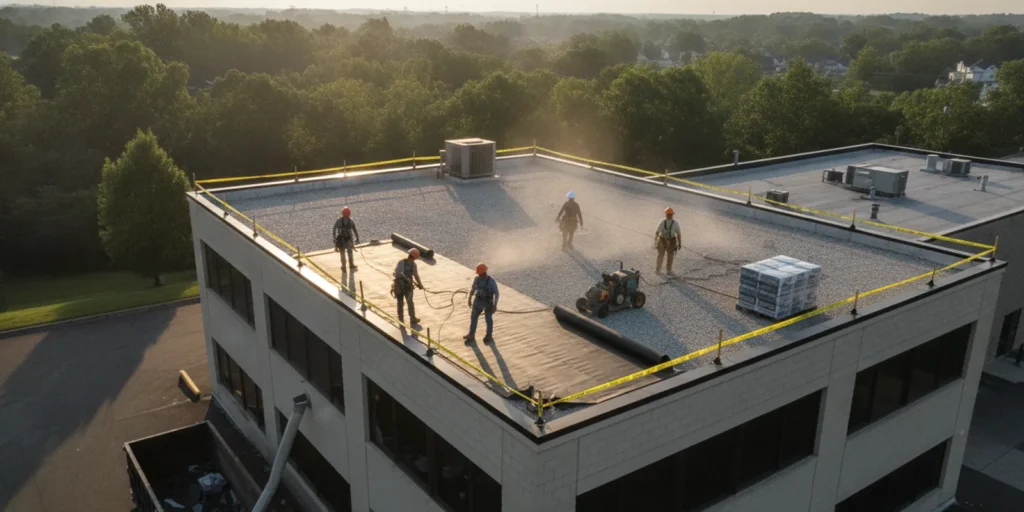
A replacement project is a sequence of decisions and work phases, not simply the days when a crew is on the roof. Planning generally starts with an evaluation and scope, followed by proposal review, approvals and permitting where required, material ordering, site preparation, installation, and final checks. Each project has its own duration. A building with a straightforward roof and clear access is different from one that has hidden wet insulation, multiple roof sections, rooftop equipment, or tenants who need uninterrupted access.
It helps to distinguish lead time from on-site work time. Lead time covers activities before installation begins, such as choosing a system, confirming product availability, coordinating building operations, and handling local requirements. On-site work time is the period when the contractor is performing the replacement. A calendar estimate should make clear which period it describes.
Ask whether the schedule measures calendar days, workdays, or the number of days a crew expects to be physically on site. These are not interchangeable. A project can have a planned start date but still depend on an owner decision, a delivery, or an inspection before a particular phase can proceed. Likewise, a schedule that estimates installation days may not include the earlier work of arranging access or confirming the scope.
As an example of why project dates should be tied to a specific scope, a public school facilities update publishes separate anticipated dates for a roof replacement’s start, continuing work, and completion. That schedule describes that project, not a universal duration for other buildings. Review the public facilities roof replacement schedule as an illustration of phased planning.
Which steps happen before installation?
Before a schedule can be meaningful, the owner and roofing contractor need a shared understanding of what is being replaced and what the building requires. A practical planning sequence includes:
- Initial assessment. Review the roof surface, drainage, edges, penetrations, transitions, and accessible interior areas for signs that merit further investigation. Document roof sections, access points, equipment, and any known leak history.
- Define the scope. Clarify whether the project covers the full roof or selected areas; whether the existing layers will be removed or another approach is being considered; and how flashing, insulation, drains, curbs, and other details will be addressed. The right scope depends on field conditions and applicable requirements.
- Compare systems and proposals. Review the proposed roofing system, included work, exclusions, preparation, cleanup, and expected sequencing. Commercial systems can differ. All In One Exteriors discusses commercial roofing services and specific TPO roofing systems for owners evaluating options.
- Coordinate approvals and permits. Determine which local building department requirements apply to the property and scope. Permit review, inspections, and approval timing are jurisdiction-specific, so confirm them early rather than assuming a standard number of days.
- Confirm materials and logistics. Verify the selected products, delivery plan, staging area, access restrictions, and any equipment needs. Do not treat a proposed start date as firm until critical materials and site arrangements are confirmed.
It can help to organize these steps as a decision calendar. Work backward from a desired construction window, but mark dependencies rather than guessing at fixed durations. For example, product selection must be settled before an order can be confirmed; delivery and staging need to be coordinated before crews can work efficiently; and a required permit or inspection may need to be completed before a defined phase. Ask the contractor which items have known dates and which remain estimates.
The owner should also identify who can approve scope changes, how questions will be handled, and which areas must stay open. If the property has several roof sections, a phasing plan may allow parts of the building to remain in use while work progresses. That is a coordination strategy, not a guarantee that disruption can be eliminated.
A simple responsibility list prevents small unanswered questions from holding up the next step. Name the person who will provide roof access, the person who reviews submittals or the proposed system, the person who coordinates tenant notices, and the person authorized to approve additional work. If one individual handles several roles, put that in the plan. If a property management company, tenant, facilities team, or owner must make a decision, allow time for the decision process rather than assuming immediate approval.
How do roof condition and project scope affect the schedule?
The visible roof surface does not always reveal the full condition of the assembly below it. Once removal begins, a contractor may find damaged decking, wet insulation, deteriorated edges, or details that were not visible during an initial review. The project team may need to document the condition, agree on appropriate corrective work, and update the sequence. A proposal should explain how concealed conditions and scope changes will be reviewed and authorized.
Before work starts, ask how unexpected conditions will be documented. A practical process identifies who will take photographs, who will explain the finding, how the proposed corrective work and its schedule effect will be described, and who can authorize the change. The goal is not to predict every concealed condition. It is to make sure the response is clear if one is discovered. Avoid assuming that any additional work will fit into the original calendar without changing other activities.
Roof geometry and detail density matter too. A large, simple roof is not necessarily more time-consuming than a smaller roof with many penetrations, parapets, curbs, transitions, or separate elevations. Rooftop HVAC units, skylights, drains, and access limitations can require careful sequencing and coordination with other trades or building staff.
Drainage needs particular attention. Existing ponding, blocked drains, or poorly coordinated slopes can affect how the replacement is planned. The project team should assess drains, scuppers, and water paths as part of the scope rather than treating the new membrane or covering as the only decision. If an owner is considering a single-ply system, it can be useful to compare the property’s needs with information about EPDM roofing and the proposed assembly.

For a multi-section property, ask the contractor to map the proposed sequence on a roof plan. One area may contain equipment that must remain accessible; another may sit above a tenant space with different operating hours. A plan that labels sections, drains, access paths, and staging locations gives the owner a concrete way to review whether the work sequence fits the building. It also makes schedule updates easier to understand: instead of saying that the project is delayed, the team can explain which area or dependency changed and what follows next.
What can delay a commercial roof replacement?
Some schedule factors can be planned for; others become clear only as work proceeds. Ask the contractor to identify the assumptions behind the proposed dates and to explain how changes will be communicated. Common considerations include:
- Weather and exposure: Rain, wind, and other unsafe conditions can interrupt roof work. The sequence should account for protecting open areas and the building interior if work must pause.
- Hidden damage: Deteriorated decking or moisture in the assembly may require additional investigation or authorized work before the system is closed in.
- Material availability: Product selection, color, accessories, and delivery coordination can affect readiness. Confirm what has been ordered and when it is expected.
- Permits and inspections: Local processes differ. Ask who is responsible for applications and inspection coordination, and whether work can proceed while a review is pending.
- Building operations: Tenant hours, loading areas, sensitive equipment, customer entrances, and noise limits may narrow the workable hours or require sections to be completed in stages.
- Site access and staging: Limited laydown space, parking, crane access, or restrictions on material movement can change daily sequencing.
- Changes to scope: A change in system, additional repairs, or owner-requested work can affect procurement and sequencing. Establish an approval process before work begins.
Weather planning deserves more than a general note that the project is weather-dependent. Ask how the crew will decide whether conditions are suitable for each day’s work, how incomplete roof areas will be protected, and who will communicate a pause or restart. The specific protection method depends on the roofing system and conditions. The owner should know which areas may be exposed during a work phase and how the project team will secure them if work stops before that phase is complete.
Ask how an interruption changes the next planned activity. If weather moves work from one roof section to another, does that change tenant notices, delivery timing, or access arrangements? If an inspection or concealed condition pauses one area, can another planned task safely proceed? These questions help distinguish an unavoidable delay from a coordination issue that could be addressed by adjusting the sequence.
For storm-damaged buildings, emergency stabilization and permanent replacement are separate decisions. A temporary measure may help protect an exposed area, but it does not establish the timing or scope of a full replacement. Owners can review emergency roofing considerations and steps after storm-related roof damage without assuming that an insurer will approve or pay for a particular project.
How should you compare a proposed schedule?
When reviewing bids, compare the schedule alongside the scope. A short projected work period may not include procurement, approvals, mobilization, or the time needed for owner decisions. Ask each bidder to describe the same milestones, and note which dates are estimates and which depend on conditions outside the contractor’s control.
| Planning phase | What to confirm | What may change the timing |
|---|---|---|
| Assessment and scope | Roof areas, visible conditions, system options, and investigation limits | Restricted access or conditions that need further review |
| Proposal and approvals | Included work, exclusions, decision-maker, and written change process | Owner review, scope revisions, or internal approvals |
| Permits and inspections | Applicable local requirements and who coordinates them | Jurisdiction review and inspection availability |
| Ordering and mobilization | Material confirmation, delivery, staging, and site access | Product availability or logistics constraints |
| Installation | Work sequence, daily protections, access, and building communication | Weather, concealed damage, and operating restrictions |
| Closeout | Final review, cleanup, documentation, and remaining items | Corrections or incomplete documentation |
The table is a checklist, not a promise that every phase takes the same amount of time. Ask for a written sequence that identifies dependencies: for example, whether material delivery must precede mobilization, or whether an inspection needs to happen before a section is covered. The commercial roofing guide for Atlanta provides another starting point for understanding commercial system considerations.
Compare proposals by asking each contractor to use the same starting assumptions. Is the estimate based on a full replacement or selected sections? Does it include the same preparation, removal approach, flashing details, and cleanup? Are material delivery, access limitations, and inspection coordination included in the proposed sequence? If one schedule is much shorter, ask what it excludes or assumes. The answer may reveal a difference in scope rather than a more efficient plan.
It can also help to separate fixed milestones from conditional ones. A decision meeting or planned delivery date may be placed on the calendar, while the exact start of a later roof section may depend on weather, a field finding, or inspection. The project schedule should show those relationships so the property manager can update occupants with useful information instead of repeating a date that may no longer apply.
How can a business prepare for work on an occupied building?
Replacement work can affect entrances, parking, deliveries, noise levels, and access to parts of the property. Owners and property managers can reduce avoidable confusion by naming a site contact and sharing a written notice with tenants or employees before mobilization. The exact plan depends on the building and the construction sequence.
- Confirm work hours, delivery routes, parking restrictions, and any areas that must remain clear.
- Identify sensitive operations, roof access controls, alarms, and equipment that may need coordination.
- Agree how occupants will receive updates if access or sequencing changes.
- Ask how the contractor will protect the building and manage debris during active work.
- Keep a record of approved scope changes and decisions so that schedule updates have clear context.
For a tenant property, identify the groups that need different information. A tenant with a delivery bay may need notice about staging or vehicle access. A business with customers on site may need a clear route to its entrance. Facilities staff may need to know when roof access, alarms, or equipment coordination is planned. A single general announcement may not answer those practical questions, so tailor the notice to the activity and affected area.
Set an update routine before installation. For example, agree who will send notices, where schedule changes will be posted, and how urgent questions reach the site contact. The routine does not need to be complicated; it needs to be predictable. If a roof section changes order, the property manager can then tell affected occupants what changed, what access is affected, and when the next update is expected.
For larger or multi-section properties, ask whether work can be sequenced by roof area and what must happen before each section starts. Discuss how access to the building will be maintained, but avoid assuming that a phased plan will keep every area open at all times. The project team should describe anticipated disruptions and the contingency plan in direct terms.
What should the schedule and proposal state?
A useful proposal should give the owner enough detail to understand both the work and the timing assumptions. The format varies by project, but consider asking for these items in writing:
- The roof areas included and the work proposed for each area.
- The anticipated sequence, including preparation, removal or other specified approach, installation, and closeout.
- Known prerequisites, such as permits, access arrangements, owner decisions, or product delivery.
- How weather, concealed conditions, and changes to scope may affect the schedule.
- Who will communicate updates, how often, and who can authorize extra work.
- How the crew will protect the building during interruptions and manage cleanup.
- What final review and project documentation are included.
Ask the contractor to explain what the owner should expect at the end of each major phase. That could include a status update after assessment, confirmation when materials and logistics are ready, notice before a crew moves to a new roof area, and a closeout review once the work is complete. The exact steps differ, but naming the handoffs makes responsibilities easier to follow.
Closeout belongs on the calendar, too. Ask what review will take place, how cleanup and remaining items will be handled, and what project documentation will be provided. If an inspection or other sign-off applies, clarify who coordinates it and when it fits into the sequence. A schedule that stops at the last installation day may omit work the owner still needs to plan for, such as reviewing completed areas or collecting project records.
Ask for clarity if a schedule shows only a start date or an estimated number of workdays. A defined sequence helps the property manager understand what must be ready, when occupants may be affected, and which issues could require a revised plan. For information on a particular building, an evaluation of commercial roofing needs is more useful than relying on a general timeline alone.
Explore commercial roofing options
Frequently asked questions
Can a commercial roof replacement happen while a business stays open?
Often the project can be planned around some ongoing operations, but the answer depends on the building, scope, access, and work sequence. Discuss entrances, deliveries, noise-sensitive areas, and any essential equipment before setting a schedule. The contractor should explain anticipated disruptions rather than promise that operations will be unaffected.
Can a roofer give an exact completion date before opening the roof?
A contractor can provide an anticipated schedule based on the known scope and assumptions. Concealed conditions, weather, inspections, or material and access issues may change it. Ask what the estimate includes and how schedule revisions will be communicated.
Do permits affect commercial roof replacement timelines in Georgia?
They may, depending on the property, scope, and local jurisdiction. Requirements and review processes can differ, so confirm them with the relevant local building department and the project team before relying on a proposed start date.
Does storm damage mean the roof must be replaced immediately?
Not necessarily. The first priority may be to assess the condition and protect the building from active water entry. The appropriate repair or replacement scope depends on inspection findings. Insurance decisions are made by the insurer under the applicable policy; no coverage outcome should be assumed.
What is the best way to get a useful project timeline?
Share the building’s operating constraints and available roof information, then request a written scope, sequence, and list of schedule assumptions. A site-specific evaluation can identify questions that a generic estimate cannot resolve.
Commercial roof replacement timelines are most useful when they are tied to a clear scope, building needs, and realistic contingencies. Start by documenting the roof and operational requirements, then compare proposals by their milestones and communication plan before choosing a path forward.