
A chimney creates a break in the roof surface, and that junction needs carefully installed flashing to shed water. If you are researching a chimney flashing roof leak in Georgia, the key is to identify where water is entering before choosing a repair. A ceiling stain near a fireplace may come from flashing, the chimney top, nearby shingles, or another detail.
Request a roof repair evaluation
How can chimney flashing lead to a roof leak?
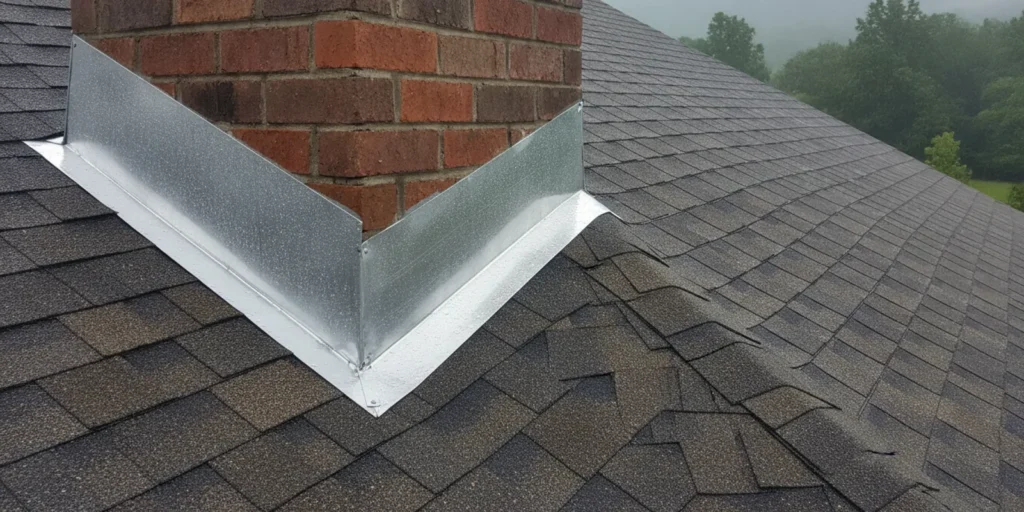
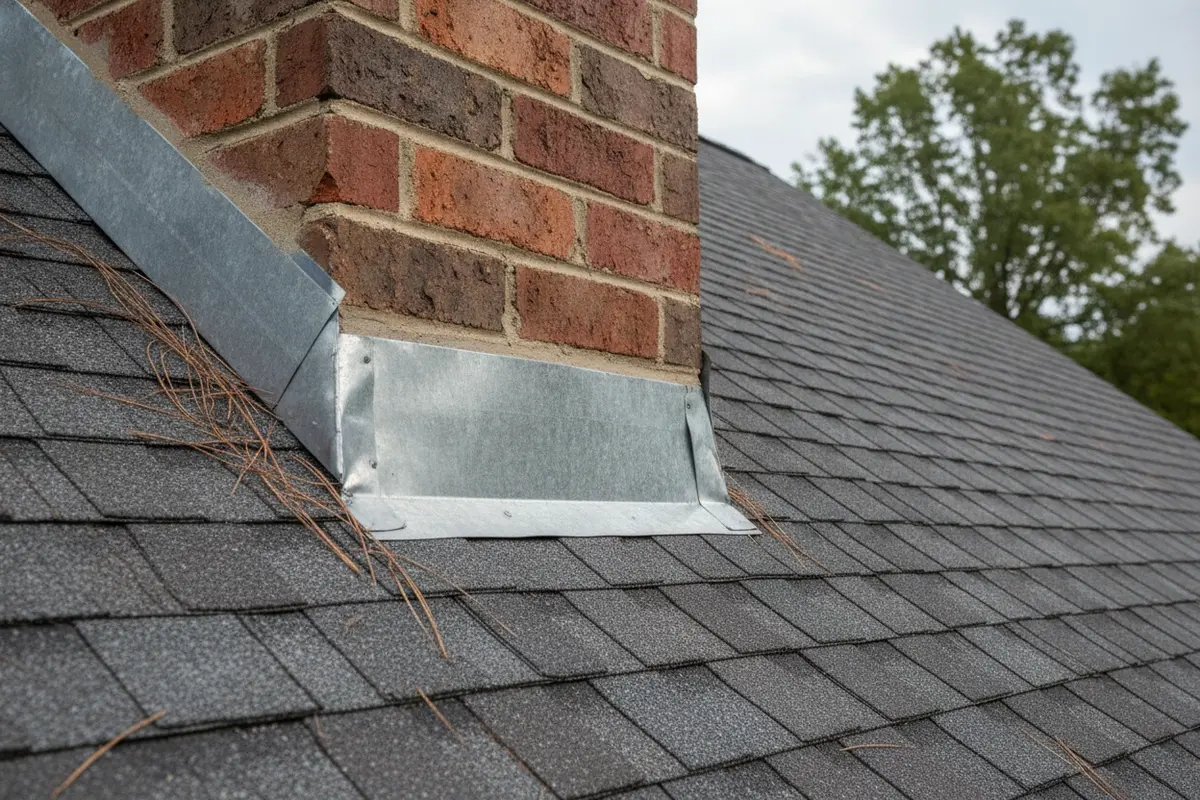
Flashing is the material and layered detail that directs water away from a joint or opening in the roof. Around a chimney, it must connect the roof covering to the chimney in a way that sheds water as it flows downhill. The exact detail depends on the roof material, chimney construction, and the shape of the intersection.
On many shingle roofs, roofers use step flashing along the sides of the chimney, weaving pieces into successive shingle courses. At the uphill side, a cricket or saddle may be used to divert water around a wider chimney. Counterflashing is set into or attached to the chimney masonry and overlaps the flashing below it. These pieces work together; a visible strip of metal alone does not prove that the full assembly is correctly layered.
Leak paths can develop if flashing is damaged, loose, corroded, poorly integrated with shingles, or separated from masonry. Old sealant may crack or pull away. A previous roof or masonry project may also have disturbed the junction. Water can travel along framing or roof decking before it appears indoors, so the point where a stain shows is not necessarily directly below the opening.
What other chimney problems can look like flashing leaks?
Not every leak near a chimney starts at the roof-to-chimney joint. Water may enter through the chimney cap, crown, masonry, or a different roof component nearby. A cap helps keep precipitation and debris out of the flue opening; the crown is the sloped top surface around it. Neither is the same thing as roof flashing.
Look for clues, but do not treat them as a diagnosis. Dampness that appears after wind-driven rain could point to an exposed or vulnerable junction, yet wind direction and water movement can make the source hard to judge. Interior staining, peeling paint, a musty smell, or damp insulation are signs to investigate. Crumbling mortar, cracked masonry, or a damaged cap may indicate chimney maintenance needs alongside any roofing work.
A chimney cap concern may require a different scope than roof-junction work. For a separate overview of that component, see the information on chimney cap replacement. If you see damage near the roofline, a roofer can assess the roof assembly and note when a masonry or chimney specialist may also be needed.
What can you check safely before calling a roofer?
Start indoors and from the ground. Note when the stain or dampness appears, whether it changes after rain, and which rooms or levels are affected. Take pictures of visible interior marks and record the date. If water is actively entering, move belongings away and place a container only if it is safe to do so. Avoid touching wet electrical fixtures or a bulging ceiling.
- From the ground, use binoculars or a phone camera zoom to look for visibly displaced shingles, loose-looking metal, or debris around the chimney.
- From inside, check the attic only if it is readily accessible and safe. Use a stable floor or walkway, avoid stepping on ceiling material, and do not approach exposed wiring or wet insulation.
- Write down the weather conditions and the time between rainfall and the leak. This information can help an evaluator investigate.
- Do not climb onto a wet, steep, or damaged roof, pull on flashing, or apply sealant as a substitute for finding the water path.
Temporary measures should not create a fall risk or conceal the source. If the ceiling is sagging, water is near electrical equipment, or the leak is worsening, keep people clear of the affected area and seek appropriate help promptly. For active roof exposure after severe weather, an emergency roofing evaluation may be more appropriate than waiting for routine scheduling.
How does a roofer evaluate the chimney and roof junction?
An evaluation starts by connecting the interior symptoms with the roof and chimney conditions. The roofer may ask when the leak occurs, whether it follows a particular direction of rain, and whether roofing or chimney work has been done recently. Access, weather, roof pitch, and safety conditions affect what can be inspected at that time.
At the roof, the evaluator may examine shingles around the chimney, the uphill and side transitions, visible flashing edges, nearby valleys, and any roof penetrations or drainage paths that could contribute to the problem. The inspection may also consider the chimney masonry and upper components. A complete assessment matters because sealing one visible seam will not solve a leak that originates elsewhere.
It can help to think of the inspection as tracing a route, rather than looking for one obvious hole. Water runs downhill over the roof, but it can also move sideways beneath a surface or follow framing after entering. The evaluator may compare the reported leak timing with the location and condition of roof details, then look for a plausible entry point. If conditions are dry during the visit, the inspection can still identify visible defects, but the source may remain uncertain until additional evidence is available.
The chimney’s uphill side deserves attention because water flowing down the roof meets that face first. On some roofs, a cricket or saddle is used to divide and direct that flow around the chimney. Its presence or design cannot be judged from a stain alone; chimney width, roof pitch, existing construction, and applicable requirements all matter. At the sides, the integration of step flashing with shingle courses is important. At the lower edge, the detail must allow water to continue onto the roof covering rather than behind it.
Ask the evaluator to distinguish what was observed from what is only suspected. For example, visible separation at a metal edge is an observation; concluding that it caused the interior stain is a diagnosis that should be supported by the surrounding conditions. If the source cannot be confirmed in one visit, ask what further inspection or monitoring would reduce uncertainty. This avoids treating a convenient visible defect as the proven cause without considering nearby roof or chimney components.
Before work begins, clarify how the repair area will be accessed and what may need to be removed to see concealed layers. Roof work around a chimney can disturb adjacent shingles or existing materials. The proposed scope should explain how the roofer will reconnect the repaired section to the surrounding roof surface, protect the building during the work, and handle any unexpected deterioration found after opening the area. Ask who will contact you if the observed conditions differ from the assumptions in the proposal.
For Georgia reroofing context, a Cherokee County, Georgia reroofing requirements document says flashing at a vertical front wall, soil stack, vent pipe, and chimney is to be applied according to the asphalt shingle specifications. This is a local government document, not a substitute for checking the current requirements that apply to a specific property. Permit and code questions should be confirmed with the relevant local building department.
After inspection, ask the roofer to explain the likely water path, what evidence supports that conclusion, and what the proposed work will include. If more than one source is possible, ask what remains uncertain and whether another trade should inspect the chimney. A clear scope helps distinguish targeted repair from broader roof work.
Which repair options might be considered?
The correct repair depends on what is damaged and how the existing roof assembly was built. A limited correction may be suitable when the surrounding materials are sound and the problem is confined to a small area. Wider replacement or reconstruction may be necessary when the flashing is extensively compromised, the surrounding shingles are deteriorated, or a prior detail was not properly integrated.
| Observed condition | Possible evaluation finding | Repair approach to discuss |
|---|---|---|
| Small, localized separation at an otherwise sound transition | A limited area may be letting water past the joint | Repair or reset the affected flashing detail, with compatible materials and proper layering |
| Damaged or poorly integrated flashing across one or more sides | The water-shedding assembly may need to be opened to assess concealed layers | Replace or rebuild the affected flashing and restore adjoining shingles as needed |
| Leak with nearby worn or damaged shingles | The entry point may involve more than the chimney transition | Address the chimney junction and evaluate the surrounding roof area together |
| Cracked crown, deteriorated masonry, or a damaged cap | The chimney itself may admit water independently of roof flashing | Coordinate the appropriate chimney repair with roofing work when needed |
| Broad roof wear or repeated problems at several details | A single patch may not address the overall condition | Compare repair scope with a broader roof assessment and replacement planning |
These are discussion points, not a diagnosis or a price list. Ask whether the proposal includes removing materials to inspect concealed conditions, replacing disturbed shingles, managing debris, and explaining any limits on what can be seen before work begins. A contractor should be able to describe why a repair is appropriately narrow or why a larger area needs attention.
The term “flashing repair” can describe very different scopes. One proposal might involve correcting a short section of exposed metal; another might require lifting shingles, removing failed flashing, addressing the chimney-side connection, and restoring several courses around the opening. The work should match the defect found. Ask whether the scope addresses the uphill side, both sidewalls, and the lower transition where applicable, rather than assuming that one repaired edge resolves every possible water path.
Materials and attachment details also matter. The repair needs to be compatible with the roof covering and chimney construction, and new work must connect properly with the sound surrounding materials. A bead of sealant can be appropriate at a specific joint, but it is not a substitute for correctly layered flashing. If the proposal relies mainly on coating or caulking over an existing assembly, ask what condition it is intended to correct and how the underlying water-shedding detail was evaluated.
For a commercial building, the evaluator should consider how the roof system meets the chimney or other masonry projection, along with drainage and access constraints. A low-slope membrane, for example, has different seams and material transitions from a shingle roof. Do not assume that a detail suitable for a home can be copied to a commercial roof. Explain the building’s use and any operating constraints so that the proposed inspection and work can be planned around them.
Request a written scope that names the area to be repaired and notes related work that is excluded. Ask how the roofer will communicate if concealed damage changes the scope, whether photographs will be provided, and what cleanup is included. A clear description helps you compare proposals on the work itself instead of relying only on a short label such as “chimney flashing.”
When is a repair enough, and when should you compare replacement?
A repair may be reasonable when the roof covering is in serviceable condition and the leak is tied to a discrete, accessible detail. Replacement becomes a consideration when the roof has widespread wear, repeated failures, or multiple areas that need substantial work. Age alone is not enough to decide; material condition, prior repairs, ventilation, and the condition of the roof deck can all matter.
Ask for the observed conditions and scope in writing. If replacement is being considered, compare what is included: removal, underlayment, flashing, new roof covering, ventilation details, cleanup, and any required permit coordination. The Georgia roof replacement timeline guide can help with planning questions, while roof replacement information describes the service option.
For a residential property, the relevant scope may be a shingle-roof repair or replacement. Commercial properties can have different assemblies and drainage details; flat and low-slope systems should not be treated as though they use the same chimney flashing detail as a steep-slope shingle roof. All In One Exteriors provides information about commercial roofing and TPO roofing systems for property owners considering those distinct roof types.
How should you prepare for a repair consultation?
Gather a few details so the conversation can focus on the problem. You do not need to identify the exact defect yourself. A concise record of symptoms and previous work can make the evaluation more useful.
Consider whether anyone has previously sealed, painted, or repaired the chimney or roof junction. Even a rough description of past work can help the evaluator understand which materials may have been disturbed. If you have paperwork or photographs from earlier roofing projects, keep them available, but do not delay addressing active water entry while searching for records.
Also describe the building’s layout and any access limitations. A tall chimney, enclosed attic, finished ceiling, or occupied commercial space may affect what can be viewed and when. Let the roofer know if there are pets, tenants, or business operations that need to be considered when arranging access. These details help set practical expectations for the evaluation without deciding the repair in advance.
After a repair, keep a copy of the written scope and any photographs or notes supplied about the completed work. If a new stain appears, record its location and timing, then contact the roofer with that information rather than applying another layer of sealant. Observations after subsequent rainfall can help determine whether further investigation is needed; they do not replace a clear explanation of what was repaired.
- Share photos of interior stains and visible exterior conditions taken safely from the ground.
- Note when the leak started, how often it occurs, and whether it happens during heavy or wind-driven rain.
- Tell the roofer about known roof or chimney repairs and approximate dates, if available.
- Identify whether the property is a home or a commercial building and mention access or occupancy concerns.
- Ask what the inspection can and cannot establish, what work is included, and how concealed damage would be handled if uncovered.
Homeowners comparing repair providers can review the company’s roofing services and residential roofing information. If the concern is part of a broader storm event, explain what you observed without assuming that a particular repair or insurance decision will follow.
Talk with All In One Exteriors about a roof repair evaluation
Frequently asked questions
Can a chimney flashing leak appear far from the chimney indoors?
Yes. Water can travel along roof decking or framing before becoming visible, so an interior stain may not be directly beneath the entry point. The roof and nearby components need to be assessed together.
Does caulk fix chimney flashing permanently?
Not necessarily. Sealant may be part of some details, but applying it over a gap does not confirm that the underlying flashing is intact or layered correctly. A lasting repair depends on identifying the source and correcting the assembly as needed.
Should I inspect the flashing from the roof?
No. Do not climb onto a wet, steep, or damaged roof. Observe from the ground and arrange a professional evaluation for close inspection.
Is a chimney cap the same as flashing?
No. A cap covers the flue opening, while flashing manages the roof-to-chimney junction. Either area may need attention, and sometimes both should be evaluated.
Can I know the repair cost from a ceiling stain?
No. The stain alone does not show the source, the condition of concealed materials, or the extent of work. An on-site assessment is needed to define a suitable scope and provide project-specific pricing.
What is the next step for a suspected chimney flashing leak?
Document the symptoms, avoid unsafe roof access, and arrange an evaluation that considers the chimney, flashing, and surrounding roof materials together. A well-defined repair starts with finding the likely water path and explaining the work needed to restore it.