
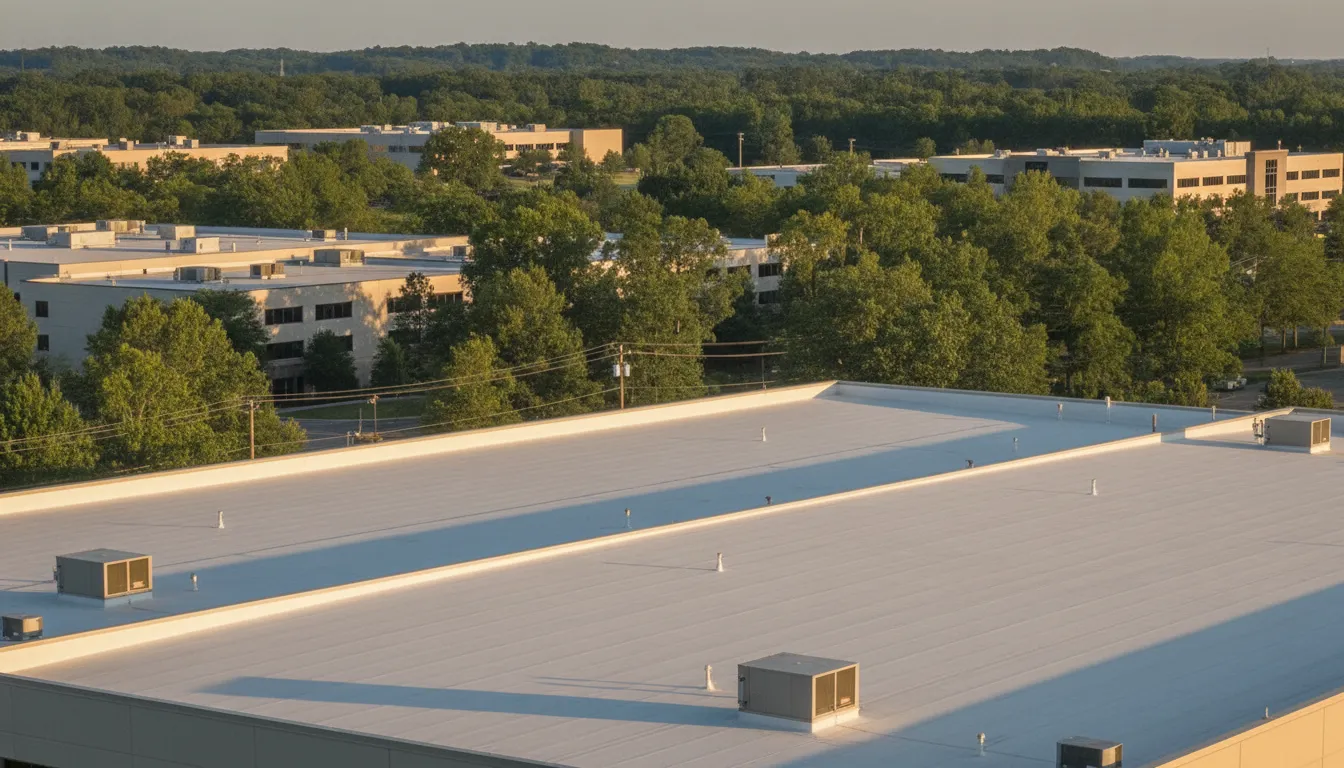
Commercial roofing in Atlanta, Georgia has to do more than keep rain out. A roof over an office, retail center, warehouse, school, or multifamily property also protects inventory, equipment, tenants, employees, and daily operations. In Metro Atlanta, property managers must account for intense sun, humidity, heavy rain, wind, roof penetrations, drainage, and the practical need to complete work without unnecessary business disruption. The right solution starts with the building, the existing roof assembly, the drainage conditions, and the owner’s priorities, not with a one-size-fits-all material.
Request a commercial roofing evaluation from All In One Exteriors to discuss the condition of your property and the options that fit its needs.
What commercial roofing includes in Metro Atlanta
Commercial roofing is a broad category. It can include a new roof for a commercial building, a replacement over an aging assembly, leak repairs, storm-related work, preventive maintenance, or a targeted solution for a low-slope section added to an otherwise steep-slope property. The correct scope depends on the roof’s slope, deck, drainage, insulation, penetrations, use of the building, access, and local conditions.
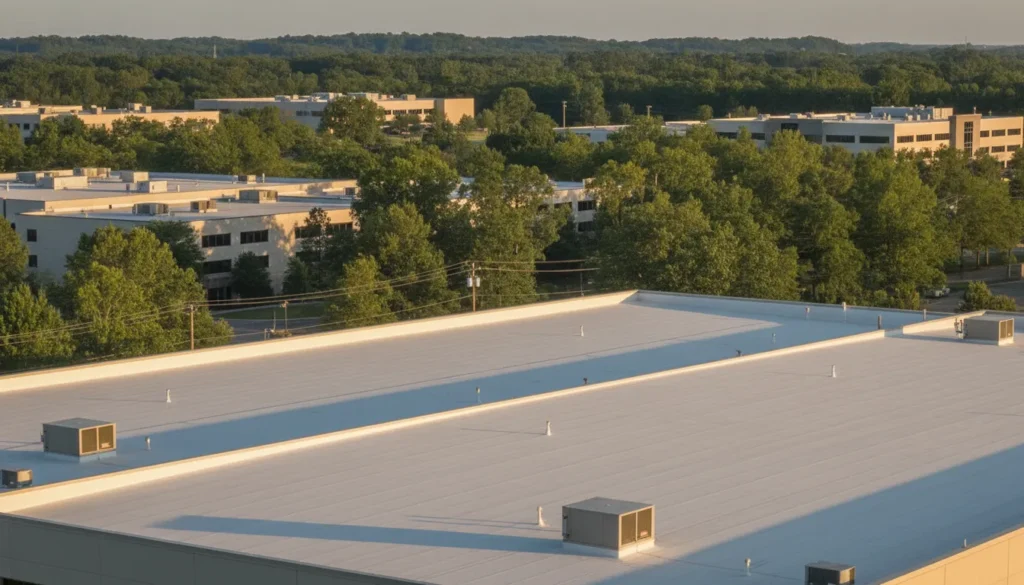
Many commercial properties use low-slope or nearly flat roof areas because that design makes efficient use of interior space and accommodates rooftop equipment. A low-slope roof is not literally level. It is designed to move water toward drains, scuppers, or gutters. That distinction matters because standing water, blocked drainage, failed flashing, and movement around penetrations can shorten the life of an otherwise sound roof.
A commercial roofing project may involve several connected decisions:
- Whether the existing roof needs a repair, restoration, recover, or full replacement.
- Which membrane or roof system fits the slope, exposure, building use, and owner’s maintenance expectations.
- How insulation, ventilation, flashing, edge metal, drains, and penetrations will be addressed.
- How the work will be sequenced around tenants, deliveries, customers, employees, and weather.
- Which manufacturer documentation, system requirements, and applicable warranty terms belong in the closeout package.
For Georgia property owners, local familiarity is useful, but technical evaluation should remain the starting point. A roof that looks similar to a neighboring building can have a different deck, drainage pattern, insulation assembly, or history of repairs.
How Atlanta weather affects a commercial roof
Metro Atlanta roofs experience a combination of conditions that can expose weaknesses over time. Strong sunlight can age exposed surfaces. Warm, humid periods can keep building materials and roof areas damp when drainage is poor. Heavy rainfall tests seams, flashings, drains, and penetrations. Wind and falling debris can damage membranes, edge details, and rooftop equipment supports. Seasonal storms can also turn a small defect into an active leak.
These conditions do not automatically make one material right for every property. They do make inspection quality and water management important. An effective evaluation should look beyond the visible leak and consider where water entered, how it traveled, whether insulation is wet, and whether the underlying problem is a failed detail or a broader roof-system issue.
Property managers should also pay attention to what happens after rain. Repeated ponding, slow drainage, staining around interior ceilings, musty areas, loose edge metal, cracked sealants, exposed fasteners, and bubbling or splitting surfaces all deserve documentation. A roof does not need to be actively leaking during an inspection to show signs of distress.
Storm response is different from routine maintenance. If water is entering a building, the first priority is to protect people, contents, and operations while arranging a professional assessment. Temporary measures may reduce additional damage, but they are not a substitute for identifying the source and planning a durable repair.
TPO roofing for Atlanta commercial buildings
Thermoplastic polyolefin, commonly called TPO, is a single-ply membrane used on many commercial low-slope roofs. TPO sheets are commonly installed over an appropriate roof assembly and joined at the seams with heat welding. The result is a continuous membrane system when the roof is properly designed, installed, and detailed.
One reason property owners consider TPO is its reflective surface options. A light-colored membrane can help reflect solar energy from the roof surface. That characteristic may be useful for buildings where heat management and energy performance are part of the owner’s goals, although actual results depend on the complete building assembly, insulation, HVAC design, operating schedule, and other factors.
TPO may be a good fit when a property manager wants to evaluate:
- A reflective single-ply membrane for a low-slope roof.
- Heat-welded seams that can be inspected as part of a quality-control process.
- A system suited to a commercial building’s rooftop equipment and penetrations.
- A membrane option that can be evaluated alongside the existing deck and insulation plan.
That does not mean TPO is automatically the best choice. The membrane still depends on proper substrate preparation, attachment or adhesion, flashing, edge details, drainage, and penetrations. Rooftop traffic, tools, equipment work, and later trades can also create punctures. A maintenance plan should document repairs and protect the membrane from avoidable damage.
All In One Exteriors identifies commercial TPO systems among its offerings, including multiple TPO system options. A property manager can review the company’s commercial TPO roofing information as a starting point, then confirm the appropriate assembly for the specific building.
EPDM roofing for Atlanta commercial buildings
Ethylene propylene diene monomer, or EPDM, is a synthetic rubber single-ply membrane used in commercial roofing. It is available in different thicknesses and can be installed using methods selected for the roof design and project requirements. EPDM is often considered for low-slope buildings with details, penetrations, and layouts that require a flexible membrane approach.
EPDM can be evaluated when a property owner values a durable membrane with a long history of commercial use, flexibility around certain details, and options that can be matched to the existing roof assembly. Black and light-colored versions may have different performance characteristics, so color and complete system design should be discussed rather than assumed.
Important EPDM planning questions include:
- How will seams, flashings, corners, curbs, and penetrations be detailed?
- What attachment or adhesion method fits the deck and expected wind exposure?
- How will drainage and recurring ponding be addressed?
- What access, rooftop traffic, and future maintenance activities could affect the membrane?
- Which manufacturer requirements and applicable warranty terms will be documented?
EPDM is not a license to overlook installation details. Seams, perimeter conditions, pipe penetrations, drains, and transitions are common inspection points. The property manager should receive a clear explanation of the proposed system, the work area, the expected disruption, and the maintenance responsibilities after installation.
All In One Exteriors also provides information about EPDM single-ply rubber roofing membrane systems. That page can help a commercial owner understand the company’s service focus before scheduling a property-specific evaluation.
TPO vs. EPDM: Which membrane should a property manager choose?
TPO and EPDM are both established single-ply membrane options, but the better choice depends on the building and the project brief. Comparing them by brand popularity alone can lead to the wrong decision. A responsible comparison considers the roof’s exposure, existing assembly, drainage, penetrations, insulation goals, rooftop traffic, installation method, maintenance plan, and the owner’s time horizon.
| Decision factor | TPO | EPDM |
|---|---|---|
| System type | Thermoplastic single-ply membrane | Synthetic rubber single-ply membrane |
| Common planning focus | Reflectivity, heat-welded seams, rooftop details, and membrane protection | Flexibility, seam and flashing details, attachment method, and membrane protection |
| Best comparison method | Review the complete assembly, seam plan, drainage, and exposure | Review the complete assembly, seam plan, drainage, and exposure |
| Maintenance questions | Inspect seams, penetrations, flashings, edges, and punctures | Inspect seams, penetrations, flashings, edges, and punctures |
| Property-manager priority | Match the system to energy goals, building use, and installation requirements | Match the system to building use, details, drainage, and installation requirements |
The table is a decision framework, not a substitute for a roof assessment. Two buildings in the same Atlanta submarket can require different systems because of roof geometry, deck condition, insulation, access, equipment, or previous repairs. A qualified commercial roofer should explain why a recommendation fits the property and what assumptions support the proposal.
For a manager comparing proposals, request the same information from each contractor: proposed system and thickness, substrate preparation, insulation plan, attachment or adhesion method, flashing and edge details, drainage work, protection of occupied areas, cleanup, closeout documents, and applicable warranty terms. Consistent scopes make proposals easier to compare than a simple total price.
Other flat-roof and low-slope solutions
TPO and EPDM are important options, but they are not the only commercial roofing solutions available in Georgia. Depending on the building and existing assembly, a contractor may also evaluate modified bitumen, self-adhered systems, built-up roofing, metal panels, or standing seam metal roofing.
Modified bitumen
Modified bitumen systems are multi-layer or membrane-based asphalt systems designed for low-slope applications. They may be considered when the building, deck, existing assembly, and project goals support that approach. The membrane type, reinforcement, surfacing, attachment method, and flashing details all matter. Modified bitumen deserves its own detailed comparison, so property managers should ask for a system-specific explanation rather than treating it as interchangeable with TPO or EPDM.
Self-adhered systems
Self-adhered roofing systems can be considered for certain projects where the substrate, application conditions, and system specifications allow. Installation still requires careful preparation and attention to laps, edges, penetrations, and transitions. A self-adhered label does not remove the need for a complete roof design.
Metal roofing panels
R-panel, PBR panel, and standing seam metal systems may be suitable for some commercial buildings, especially where the roof design, appearance, slope, durability goals, and structural requirements support metal. Metal roofs have their own details, including fasteners, seams, closures, penetrations, expansion, and corrosion control. They should be evaluated as complete systems, not as a simple material swap.
All In One Exteriors lists R-panel and PBR panel systems and standing seam metal roofing systems among its commercial roofing information. Those options can be discussed during a broader property evaluation when a low-slope membrane is not the only practical direction.
Repair, recover, or replace a commercial roof?
A leak does not always mean the entire roof must be replaced. A recurring leak also should not be treated as a small repair without understanding its cause. The right path depends on the extent of damage, the condition of the roof assembly, the remaining service life, wet insulation, drainage, code considerations, previous repairs, and the owner’s operational and capital-planning goals.
When targeted repair may be appropriate
A targeted repair may make sense when the problem is localized, the surrounding roof is in good condition, the assembly is dry and stable, and the repair can be detailed reliably. Examples can include a damaged flashing area, an isolated puncture, a failed seal at a penetration, or a limited edge condition. Documentation matters because a series of isolated repairs can eventually indicate a broader system problem.
When a recover or restoration may be considered
A recover or restoration approach may be considered when the existing roof is eligible for that work, the deck and assembly meet the requirements, drainage can be addressed, and the proposed system will perform as intended. The contractor should explain how the existing roof will be inspected, what areas will be repaired, how moisture will be identified, and which conditions would make a recover inappropriate.
When replacement deserves serious consideration
Replacement becomes more likely when damage is widespread, the roof has reached the end of its service life, insulation is wet across substantial areas, drainage problems are persistent, or previous repairs no longer provide a reliable solution. A replacement proposal should show how the new roof will address the causes of past failures, not just cover the visible symptoms.
Ask for photos, marked-up roof plans when useful, moisture or condition findings where applicable, and a plain-language explanation of the recommendation. Clear documentation helps owners approve necessary work and helps future managers understand what was installed.
What a commercial roofing project should include
A well-managed project begins before materials arrive. Property owners and managers should expect a process that connects the inspection, scope, installation plan, communication plan, and closeout documents.
1. Property and roof assessment
The contractor reviews the roof surface, edges, penetrations, drains, scuppers, curbs, equipment areas, flashing, interior leak evidence, and accessible conditions. The assessment should distinguish observed facts from assumptions and identify areas that require additional investigation.
2. Scope and system recommendation
The proposal should state what work is included, which areas are excluded, how the existing roof will be handled, and what system is proposed. It should identify preparation, insulation, membrane or panel work, flashing, edge metal, drainage, cleanup, and closeout requirements.
3. Occupied-building coordination
Commercial roofing occurs around real people and real operations. The schedule should account for access, deliveries, tenant communication, noise, odors, rooftop equipment, pedestrian areas, parking, weather, and daily cleanup. If work must be phased, the proposal should explain how the phases affect the property.
4. Installation and quality control
Installation quality depends on following the selected system’s requirements and protecting completed work. The project team should monitor seams, fasteners, adhesives, flashings, penetrations, edges, drainage, and transitions. The property manager should know who to contact if a concern appears during construction.
5. Closeout and maintenance plan
At completion, request final photos, product and system information, warranty documentation where applicable, repair notes, maintenance recommendations, and any remaining owner responsibilities. A closeout package is especially valuable when properties change managers or when future repairs need to match an existing assembly.
Talk with All In One Exteriors about a commercial roof repair, replacement, or maintenance evaluation before a recurring leak becomes a larger interruption.
How to build a practical commercial roof maintenance plan
Maintenance is not a promise that a roof will never leak. It is a way to find conditions earlier, document changes, protect the roof system, and plan repairs before they become emergencies. The plan should match the building, the roof assembly, the age of the system, occupancy, rooftop traffic, and the owner’s risk tolerance.
A practical plan may include:
- A documented baseline inspection after installation or at the start of management.
- Routine visual inspections on a schedule appropriate for the property and roof system.
- Additional checks after severe weather or work by other rooftop trades.
- Cleaning and inspection of drains, scuppers, gutters, and overflow paths.
- Review of flashings, seams, edge metal, penetrations, curbs, and sealants.
- Removal of avoidable debris and documentation of rooftop traffic or damage.
- Interior checks for ceiling stains, damp insulation, odors, and recurring leak locations.
- Photos and dated notes so the manager can compare conditions over time.
- Prompt escalation of active leaks, ponding, exposed materials, or safety concerns.
Maintenance should also include coordination with HVAC, solar, signage, and other contractors who access the roof. Many avoidable problems occur after a different trade moves equipment, leaves debris, punctures a membrane, or changes a flashing detail. A roof-access policy and a record of rooftop work can protect both the building and the project history.
All In One Exteriors describes commercial roofing installation, repair, and maintenance among its capabilities. Property managers can use the company’s commercial roofing service page to begin a conversation about a property-specific maintenance scope.
How much does commercial roofing cost in Atlanta?
There is no responsible single price for commercial roofing in Atlanta. A useful proposal must account for the actual property and the selected system. Roof area is only one input. A small roof with difficult access, extensive penetrations, wet insulation, complex edges, or substantial preparation can require more work than a larger, simpler roof.
Common cost drivers include:
- Roof size, slope, geometry, and access.
- Existing membrane, panels, insulation, and deck condition.
- Amount of tear-off, disposal, preparation, or recovery work.
- Membrane type, thickness, attachment method, and system accessories.
- Flashing, curbs, drains, scuppers, edge metal, and penetration details.
- Insulation and energy-performance requirements.
- Rooftop equipment, tenant coordination, phasing, and site protection.
- Weather, material availability, permits, safety requirements, and scheduling.
- Documentation, inspections, testing, and applicable warranty requirements.
Instead of relying on an online number that may not match the building, request a site evaluation and a written scope. Ask the contractor to identify allowances, exclusions, optional work, and conditions that could change the final scope. All In One Exteriors uses a consultation and quote model rather than publishing commercial roof prices, so a property-specific conversation is the appropriate next step.
Questions to ask a commercial roofing contractor
Property managers can improve proposal quality by asking consistent questions before selecting a contractor:
- What did you observe about the existing roof, drainage, deck, insulation, and penetrations?
- Why are you recommending repair, recover, restoration, or replacement?
- Why does the proposed TPO, EPDM, modified bitumen, metal, or other system fit this building?
- What preparation is included, and what conditions could change the scope?
- How will occupants, tenants, customers, deliveries, and rooftop equipment be protected?
- How will the work be phased if the building must remain operational?
- How will seams, flashings, edges, drains, and penetrations be inspected?
- What manufacturer documentation and applicable warranty terms will be provided?
- What maintenance should the owner schedule after the project is complete?
- Who will handle questions during the project and after closeout?
Look for answers that are specific to the property. A generic material list or a low total without a clear scope makes it difficult to compare risk. A good proposal should help the owner understand what is being done, why it is being done, and what responsibilities remain after the crew leaves.
Why Metro Atlanta property owners work with All In One Exteriors
All In One Exteriors is a Georgia-based roofing and exterior construction company serving commercial and residential property owners in Metro Atlanta and surrounding areas. The company states that it is factory trained and certified by most major roofing manufacturers and offers commercial systems that include TPO, EPDM, modified bitumen, self-adhered systems, R-panel and PBR panels, and standing seam metal roofing.
The company has more than 25 years of roofing-industry experience and serves communities including Alpharetta, Atlanta, Sandy Springs, Marietta, Smyrna, Brookhaven, Dunwoody, Peachtree Corners, and Mableton. The exact service plan, material selection, schedule, and applicable warranty terms should be confirmed for each property during the consultation.
For a commercial owner or property manager, the practical value of a broad roofing and exterior-service company is the ability to discuss the building envelope as a whole. Roofing remains the primary decision, but coordinated conversations about gutters, exterior walls, windows, doors, insulation, or solar may help identify related conditions that affect water management and long-term planning.
Schedule a Metro Atlanta commercial roofing consultation with All In One Exteriors for an evaluation focused on your building, roof system, and operating needs.
Frequently asked questions about commercial roofing in Atlanta
What is the most common commercial roofing system in Atlanta?
There is no single system that is best for every Atlanta commercial building. TPO and EPDM are widely used low-slope membrane options, while modified bitumen, self-adhered systems, built-up roofing, metal panels, and standing seam systems may fit other properties. The roof slope, existing assembly, drainage, penetrations, insulation, access, and owner priorities should guide the recommendation.
Is TPO or EPDM better for a commercial building?
Neither is automatically better for every building. TPO may appeal to owners evaluating reflective surfaces and heat-welded seams, while EPDM may fit projects where a synthetic rubber membrane and flexible detailing approach are appropriate. A contractor should compare complete assemblies and installation requirements for the specific roof rather than recommending a membrane in isolation.
How often should a commercial roof be inspected?
The right schedule depends on the roof system, age, exposure, occupancy, rooftop traffic, and maintenance history. Many property managers use routine inspections plus additional checks after severe weather or rooftop work. The important point is to document conditions and address drainage, penetrations, edges, seams, and interior evidence before a small issue grows.
Can a commercial roof be repaired instead of replaced?
Sometimes. A targeted repair may be appropriate when the defect is localized and the surrounding system remains serviceable. Replacement or a larger rehabilitation may be more appropriate when damage is widespread, the system is near the end of its useful life, insulation is wet, or repeated repairs are not solving the underlying problem. An inspection should support the recommendation.
How do property managers compare commercial roofing proposals?
Compare the proposed system, thickness, preparation, insulation, attachment method, flashing, edge work, drainage, phasing, site protection, cleanup, documentation, and applicable warranty terms. Ask each contractor to identify exclusions and allowances. Comparing complete scopes is more useful than comparing totals without context.
Does All In One Exteriors serve commercial properties outside Alpharetta?
All In One Exteriors is based in Alpharetta and lists commercial roofing service across Metro Atlanta communities including Atlanta, Sandy Springs, Marietta, Smyrna, Brookhaven, Dunwoody, Peachtree Corners, and Mableton. Confirm availability, scheduling, and the scope of work for your specific property when requesting an evaluation.
Plan the next step for your commercial roof
A commercial roof is an operating asset, not just a surface above the building. The best plan connects the roof condition, water management, building use, material choice, construction schedule, maintenance needs, and long-term ownership goals. Whether the property needs a repair, a membrane comparison, a maintenance plan, or a full replacement discussion, a property-specific assessment is the most reliable place to start.
Contact All In One Exteriors for a commercial roofing evaluation in Metro Atlanta and discuss the right next step for your property.